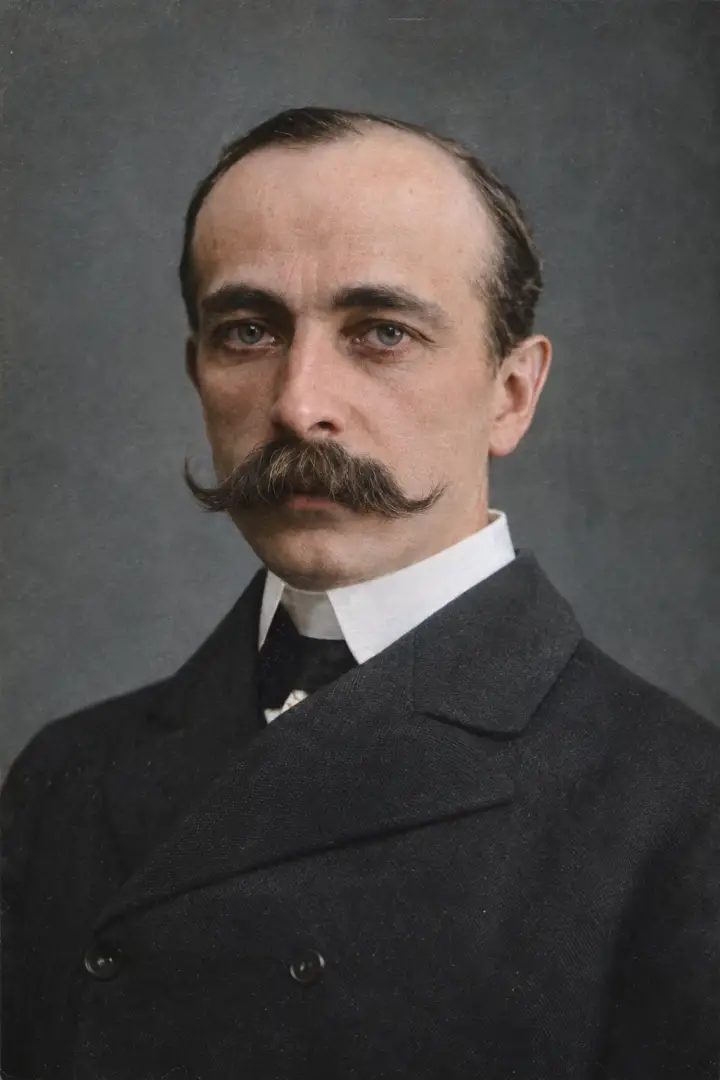

Edited by:
redazione
Mountaineer, writer and photographer from Turin
Personal details
Name: Guido Rey
Born: 20 November 1861 – Turin
Died: 24 June 1935 – Turin
Nationality: Italian
Occupation: mountaineer, writer, photographer and industrialist
Biography
Guido Rey was born in Turin into a family of textile industrialists of French origin. His father, Giacomo Vincenzo, ran the company and was a member of the Italian Parliament; his mother was Lydia Mongenet de Resencourt. The family had links to the Sella family of Biella: Quintino Sella, founder of the Italian Alpine Club in 1863, had married Clotilde Rey, sister of Guido’s father, and was therefore his uncle by marriage. It was his uncle who introduced him to the mountains, through the youthful excursions in the Biella mountains during which Rey recalled seeing the Matterhorn for the first time.
Having obtained his classical school-leaving certificate at the Gioberti Grammar School in 1879, he did not go on to university. He devoted himself to literature, drawing and painting, frequenting Turin’s artistic circles, whilst also working in the family business, which enabled him to travel to various European countries and other continents. On his father’s death in 1907, he took over the management of the business alongside his brother Ugo. In 1885, another brother, Mario, had died during a climb in the Colle del Gigante area, an incident that shaped his relationship with the mountains.
His mountaineering activities centred on the Western Alps and revolved around the Matterhorn, which he climbed on several occasions, taking a particular interest in the Furggen Ridge. In 1899, after several attempts from below, he failed to complete the ascent: he climbed with the guides Maquignaz and attempted the passage using a rope thrown down from above, then abseiled from the summit using a rope ladder to explore the final rocky drop. The episode went down in mountaineering history, but Rey himself acknowledged that he had not achieved a complete first ascent of the ridge. From 1904, he frequented the Mont Blanc massif with Ugo De Amicis, son of Edmondo, and with guides from the Aosta Valley; from 1910 he turned his attention to the Dolomites, where climbing centred on short, technically difficult and highly exposed routes, and climbed with De Amicis and guides such as Tita Piaz. These experiences gave rise to Acrobatic Mountaineering.
As a writer, he published Il Monte Cervino, with an introduction by Edmondo De Amicis and illustrations by Edoardo Rubino, which weaves together the history of the mountain’s exploration, personal memories and reflections on the meaning ofmountaineering, and was translated into French, English and German. One of his phrases sums up the conception of the mountain that runs through these books: “I believed, and still believe, that the struggle with theAlps to be as useful as work, as noble as an art, as beautiful as a faith". It was reproduced for many years on the membership cards of the Italian Alpine Club.
Critics have offered mixed reviews. Gian Piero Motti, in his history of mountaineering, acknowledges the breadth and quality of his ascents and his role in popularisingmountaineering through his writings, in particular Acrobatic Mountaineering, but criticises him for his rhetoric and the idealisation of the mountaineer and the guides, which, in his view, exclude the harshest aspects of the activity. Mario Mila, quoted by Motti, saw the search for a solution to the Furggen as a stubborn battle that went so far as to resort to a stratagem.
Alongside mountaineering, he practised photography. Influenced by his cousin Vittorio Sella, he began by documenting climbs and Alpine landscapes, before turning to pictorialist photography, with compositions inspired by classical, Flemish and Dutch painting, created by carefully arranging subjects and objects. He exhibited from 1892 onwards, received awards at the Turin exhibition of 1898 and the Florence exhibition of 1899, took part in the1902 International Exhibition of Modern Decorative Art in Turin and was published in international magazines such as The Studio and Camera Work.
At the outbreak of the First World War, he openly supported intervention, partly due to his connections with the Trentino irredentist circles. Unfit for service in the fighting forces due to his age, he volunteered for the Italian Red Cross, making his car available for their use. In 1916, a serious car accident further compromised his health. After the war, he supported the Fascist movement: this stance, documented in his private correspondence [to be verified: study citing it], is a controversial aspect of his biography.
In his later years, he continued to visit Breuil, where he owned a house at the foot of the Matterhorn, and opposed the construction of the carriage road and the transformation of the valley into a tourist destination. In 1934, he was awarded the Legion of Honour by the French government for his services to mountaineering [to be verified: source]. He died in Turin on 24 June 1935, in the family mansion on Via Cavour.
Sources give conflicting dates of birth: 20 November according to the Dizionario Biografico degli Italiani, and 26 and 28 November according to other studies. The date remains to be verified against his birth certificate or the typewritten autobiography held by the National Library of the Italian Alpine Club.
Mountaineering achievements
Ciamarella – year [to be verified] – ascent
Bessanese – year [to be verified] – ascent, north face
Punta Bianca – year [to be verified] – Tiefenmatten ridge
Monviso – year [to be verified] – two new routes
Meije – year [to be verified] – Italian first ascent, with Alessandro Sella
Grivola – year [to be verified] – north ridge, first Italian ascent and second ascent overall
Lyskamm – year [to be verified] – south face
Dent d'Hérens – year [to be verified] – ascent
Punta Dufour – year [to be verified] – south-south-west ridge (Rey ridge), repeat ascent, not first ascent
Matterhorn - 1899 - circumnavigation of the Testa del Cervino on the south face
Matterhorn - 24 August 1899 [to be verified: year, one source gives 1889] - attempt on the Furggen ridge with 80 metres of rope thrown fromtop, with Jean-Antoine and Aimé Maquignaz
Matterhorn - 28 August 1899 [to be verified: year; one source gives 1889] - descent using a rope ladder from the final drop on the Furggen ridge
Matterhorn - 1900 - exploratory reconnaissance on the Furggen ridge
Matterhorn - 16 September 1900 – Zmutt Ridge, with Daniele, Ange and Jean-Antoine Maquignaz
Mont Blanc – from 1904 - Grépon, Grands Charmoz, Dent du Requin, Petit Dru and Aiguille Verte, with Ugo De Amicis and guides from the Aosta Valley, including Ange and Aimé Maquignaz
Dolomites – from 1910 - Catinaccio, the Vajolet Towers, Marmolada and the Pale di San Martino, with Ugo De Amicis and guides including Tita Piaz
Antelao – 1913 – ascent
Matterhorn - 22 August 1922 [to be verified: year] – De Amicis ridge with Ange Maquignaz, up to 3,558 m
Places and names
Rey ridge - Monte Rosa, Punta Dufour – south-south-west ridge, named after Guido Rey, who was not the first to climb it
Works
‘Alpinismo a quattro mani’, Turin, Roux Frassati & C., 1898 – with Giovanni Saragat
‘Mountaineering Family: Characters and Landscapes’, Turin, S. Lattes & C., 1904 – with Giovanni Saragat
The Matterhorn, Milan, Ulrico Hoepli, 1904
Acrobatic Mountaineering, Turin, S. Lattes & C., 1914
Alpine Dawn, a pamphlet associated with SUCAI, [c. 1914]
The Return of Time, Turin, Alfredo Formica, 1929
The End of Mountaineering, Turin, Edizioni Montes, 1939 – posthumous, edited by Adolfo Balliano
Complete Works, four volumes, Turin, Montes Collection, 1953–1954 – posthumous
Letters to Nino. Letters from Guido Rey to Nino Peterlongo, 1977
Bibliography
As a writer
Giuseppe Garimoldi (ed.), Guido Rey. From mountaineering to literature and back, 1986
As a key reference
Sandro Prada, Guido Rey the Master, 1956
Gian Piero Motti, The History of Mountaineering, 1994
Filippo Maggia (ed.), Guido Rey, Pictorialist Photographer, 2004
Alessandro Pastore, Rey, Guido, in Biographical Dictionary of Italians, vol. 87, 2016
Mattia Gargano and Veronica Lisino (eds.), Guido Rey. An amateur between mountaineering, photography and literature, exhibition catalogue, 2025